GutCited

Omega-3 Fatty Acids (EPA/DHA) 그림

3 동료 심사 연구의 그림

전체 Saccharomyces boulardii Lactobacillus acidophilus Bifidobacterium lactis Lactobacillus plantarum Bifidobacterium longum Bifidobacterium bifidum Lactobacillus gasseri Bacillus coagulans Inulin Fructooligosaccharides (FOS) Galactooligosaccharides (GOS) Psyllium Husk Lactase Pancreatic Enzymes (Pancrelipase) Alpha-Galactosidase L-Glutamine N-Acetyl Cysteine (NAC) Peppermint Oil Ginger Berberine Curcumin Zinc Vitamin D Vitamin A Butyrate (Sodium/Calcium Butyrate) Omega-3 Fatty Acids (EPA/DHA) Medium-Chain Triglycerides (MCT Oil) Bovine Colostrum Aloe Vera (Inner Leaf Gel)
All Types Chart Diagram Photograph Flowchart Forest Plot Micrograph Other
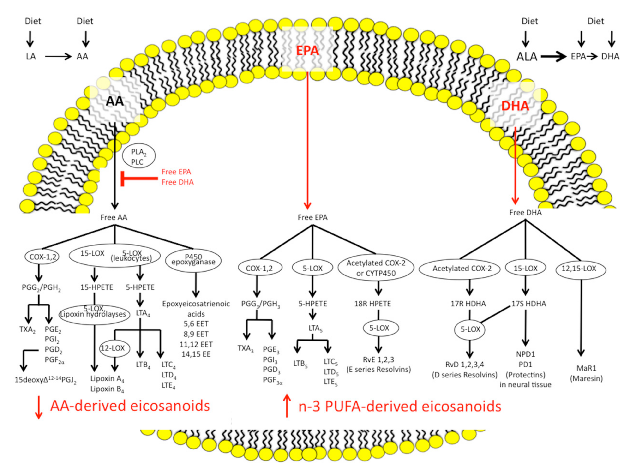
Figure 1. Outline of the pathways of synthesis for the n-3 and n-6 polyunsaturated fatty acids eicosanoids and the specialised pro-resolving mediators. AA, arachidonic acid; ALA, α-linolenic acid; COX, cyclooxygenase; CYTP450, cytochrome P450 enzymes; DHA
Figure 5 Diagram

N-3 and n-6 polyunsaturated fatty acids follow distinct biosynthetic pathways to produce eicosanoids and specialized pro-resolving mediators. This diagram outlines the synthesis routes from alpha-linolenic acid and arachidonic acid through COX and cytochrome P450 enzymes to their bioactive lipid products.

The Imbalance between n-6/n-3 Polyunsaturated Fatty Acids and Inflammatory Bowel Disease: A …
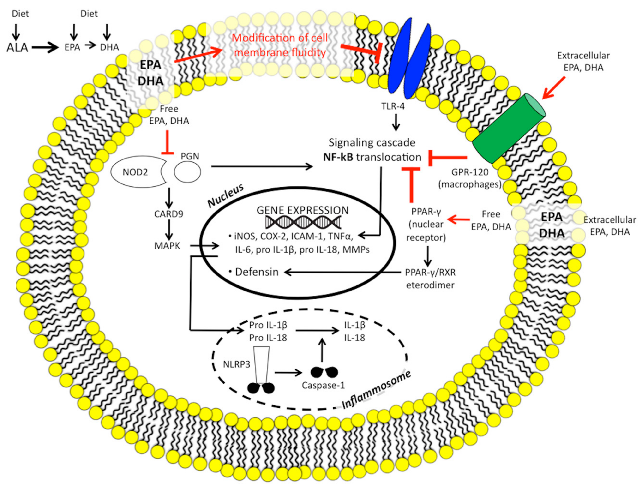
Figure 2. The n-3 polyunsaturated fatty acid targets of intestinal innate immunity. ALA, α-linolenic acid; CARD, caspase recognition domain; COX, cyclooxygenase; DHA, docosahexaenoic acid; EPA, eicosapentaenoic acid; GPR, G-protein coupled receptor; ICAM,
Figure 6 Diagram

N-3 polyunsaturated fatty acids modulate intestinal innate immunity through multiple receptor and signaling targets. This diagram maps the interactions of DHA and EPA with G-protein coupled receptors, COX enzymes, and caspase recognition domains in intestinal immune cells.

The Imbalance between n-6/n-3 Polyunsaturated Fatty Acids and Inflammatory Bowel Disease: A …
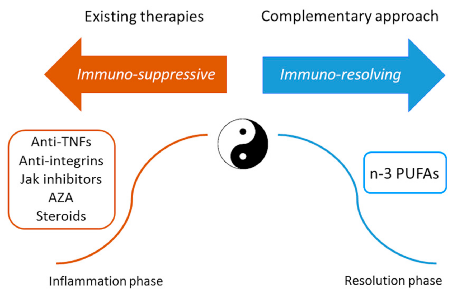
Figure 3. The immuno-suppressive and immuno-resolving approaches of inflammatory bowel disease treatment. AZA, azathioprine; PUFA, polyunsaturated fatty acid; TNF, tumour necrosis factor.
Figure 7 Diagram

Current IBD treatments employ both immuno-suppressive and immuno-resolving strategies. This diagram contrasts conventional therapies (azathioprine, anti-TNF agents) with emerging PUFA-based approaches that promote active resolution of intestinal inflammation.

The Imbalance between n-6/n-3 Polyunsaturated Fatty Acids and Inflammatory Bowel Disease: A …