GutCited
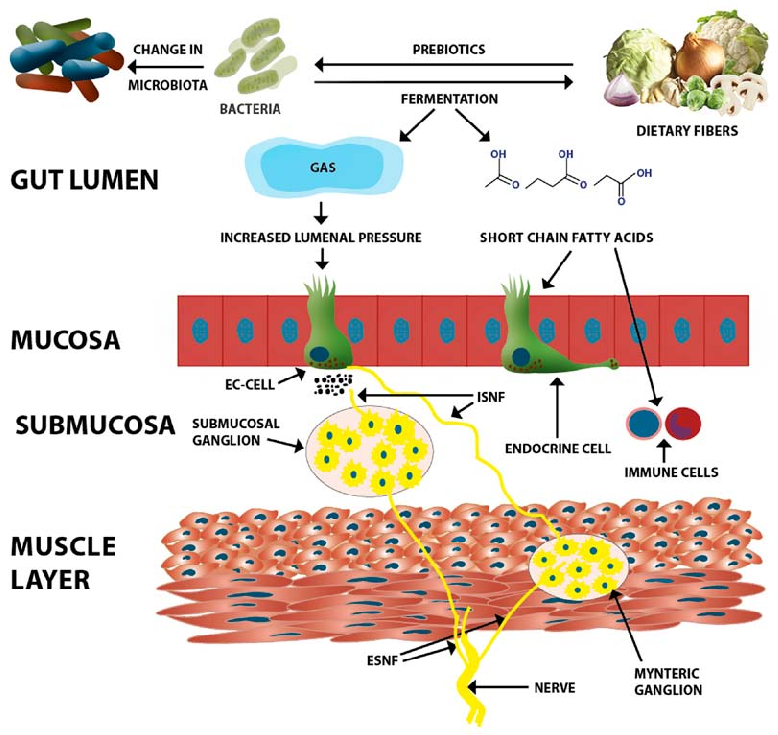
Figure 1. Likely mechanisms through which dietary fiber affects the functions of the gastrointestinal tract. Dietary fiber acts as a prebiotic to intestinal microbiota that causes changes in their composition and induces the growth of beneficial bacteria.
Figure 3. Figure 1. Likely mechanisms through which dietary fiber affects the functions of the gastrointestinal tract. Dietary fiber acts as a prebiotic to intestinal microbiota that causes changes in their composition and induces the growth of beneficial bacteria. The intestinal microbiota in turn causes the fermentation of the dietary fiber, producing gas, short-chain fatty acids, and other byproducts. The gas production increases the fecal mass and increases the luminal pressure. These mechanisms together with lowering of the luminal pH stimulate the secretion of serotonin from the EC-cell. Serotonin plays an important role in visceral sensitivity. Short-chain fatty acids act on intestinal endocrine cells and/or the neurons of the enteric nervous system to change gastrointestinal motility and secretion. Short-chain fatty acids act also on immune cells and thereby reduce inflammation. EC-cell, enterochromaffin cell; ISNF, intrinsic sensory nerve fibers; ESNF, extrinsic sensory nerve fibers.

विवरण

Dietary fiber acts as a prebiotic for intestinal microbiota, promoting growth of beneficial bacteria and production of short-chain fatty acids. This diagram illustrates multiple mechanisms through which fiber affects gastrointestinal function, including modulation of gut microbiome composition and intestinal barrier integrity.

Figure 3

Diagram
778 × 735px · 452.6 केबी 

Source Paper

Dietary fiber in irritable bowel syndrome (Review).

International journal of molecular medicine (2017)

PMID: 28731144

DOI: 10.3892/ijmm.2017.3072

Cite This Figure

![Figure 3: Dietary fiber acts as a prebiotic for intestinal microbiota, promoting growth of beneficial bacteria and production of short-chain fatty acids. This diagram illustrates multiple mechanisms through which fiber affects gastrointestinal function, including modulation of gut microbiome composition and intestinal barrier integrity.](https://pdfs.citedhealth.com/figures/28731144/64.png)

> Source: Magdy El-Salhy et al. "Dietary fiber in irritable bowel syndrome (Review).." *International journal of molecular medicine*, 2017. PMID: [28731144](https://pubmed.ncbi.nlm.nih.gov/28731144/)
<figure>
  <img src="https://pdfs.citedhealth.com/figures/28731144/64.png" alt="Dietary fiber acts as a prebiotic for intestinal microbiota, promoting growth of beneficial bacteria and production of short-chain fatty acids. This diagram illustrates multiple mechanisms through which fiber affects gastrointestinal function, including modulation of gut microbiome composition and intestinal barrier integrity." />
  <figcaption>Figure 3. Dietary fiber acts as a prebiotic for intestinal microbiota, promoting growth of beneficial bacteria and production of short-chain fatty acids. This diagram illustrates multiple mechanisms through which fiber affects gastrointestinal function, including modulation of gut microbiome composition and intestinal barrier integrity.<br>  Source: Magdy El-Salhy et al. "Dietary fiber in irritable bowel syndrome (Review).." <em>International journal of molecular medicine</em>, 2017. PMID: <a href="https://pubmed.ncbi.nlm.nih.gov/28731144/">28731144</a></figcaption>
</figure>
