GutCited
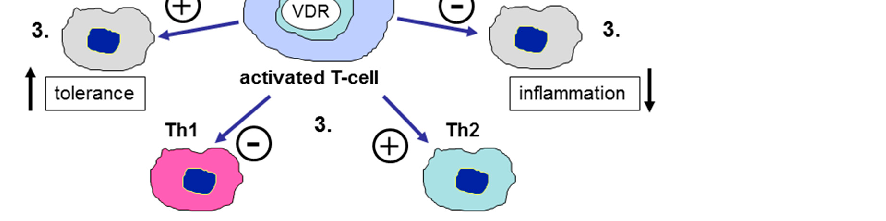
Figure 1. Vitamin D and barrier function in the gastrointestinal tract. Schematic representation of the expression of the vitamin D receptor (VDR) and vitamin D-activating enzyme (CYP27B1) in human colonic epithelial cells, antigen presenting cells such a
Figure 6. Figure 1. Vitamin D and barrier function in the gastrointestinal tract. Schematic representation of the expression of the vitamin D receptor (VDR) and vitamin D-activating enzyme (CYP27B1) in human colonic epithelial cells, antigen presenting cells such as dendritic cells (DC), and T cells. Immune responses to vitamin D occur either via systemic 1,25-dihydroxyvitamin D (1,25-(OH)2D) or local conversion of 25-hydroxyvitamin D (25-OH-D) to 1,25-(OH)2D. Possible target mechanisms include: 1) interface with microbiota (induction of antibacterials such as angiogenin, cathelcidin (LL37), defensins or intracellular pathogen recognition proteins such as nucleotide-binding oligomerisation domain containing 2 (NOD2)); 2) T cell homing to sites of inflammation; 3) suppression of inflammatory Th17 and Th1 cells and induction of tolerogenic Treg and Th2 cells; 4) enhanced expression of epithelial membrane junction proteins

الوصف

Vitamin D receptor expression and vitamin D-activating enzyme CYP27B1 are present in human colonic epithelial cells, enabling local production of active calcitriol. This paracrine signaling enhances tight junction integrity and antimicrobial defense at the mucosal surface.
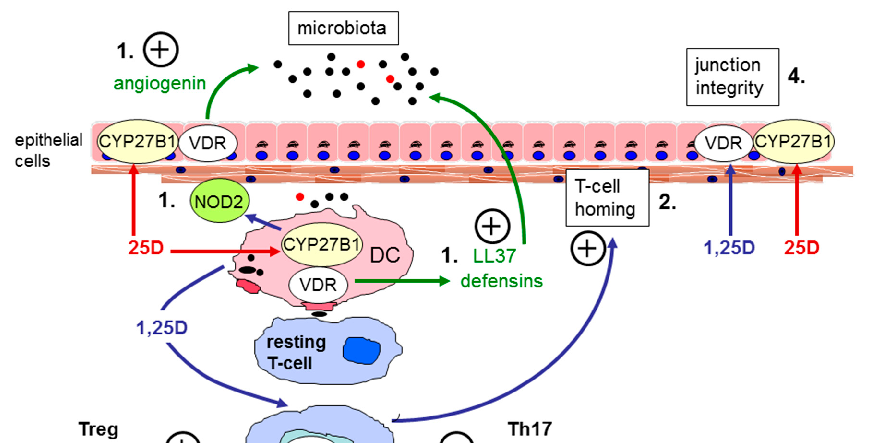
Figure 6

Diagram
886 × 221px · 59,0 ك.ب

Source Paper

The Role of Vitamin D in Inflammatory Bowel Disease: Mechanism to Management.

Nutrients (2019)

PMID: 31067701

DOI: 10.3390/nu11051019

Cite This Figure

![Figure 6: Vitamin D receptor expression and vitamin D-activating enzyme CYP27B1 are present in human colonic epithelial cells, enabling local production of active calcitriol. This paracrine signaling enhances tight junction integrity and antimicrobial defense at the mucosal surface.](https://pdfs.citedhealth.com/figures/31067701/110.png)

> Source: Jane Fletcher et al. "The Role of Vitamin D in Inflammatory Bowel Disease: Mechanism to Management.." *Nutrients*, 2019. PMID: [31067701](https://pubmed.ncbi.nlm.nih.gov/31067701/)
<figure>
  <img src="https://pdfs.citedhealth.com/figures/31067701/110.png" alt="Vitamin D receptor expression and vitamin D-activating enzyme CYP27B1 are present in human colonic epithelial cells, enabling local production of active calcitriol. This paracrine signaling enhances tight junction integrity and antimicrobial defense at the mucosal surface." />
  <figcaption>Figure 6. Vitamin D receptor expression and vitamin D-activating enzyme CYP27B1 are present in human colonic epithelial cells, enabling local production of active calcitriol. This paracrine signaling enhances tight junction integrity and antimicrobial defense at the mucosal surface.<br>  Source: Jane Fletcher et al. "The Role of Vitamin D in Inflammatory Bowel Disease: Mechanism to Management.." <em>Nutrients</em>, 2019. PMID: <a href="https://pubmed.ncbi.nlm.nih.gov/31067701/">31067701</a></figcaption>
</figure>
