Açıklama
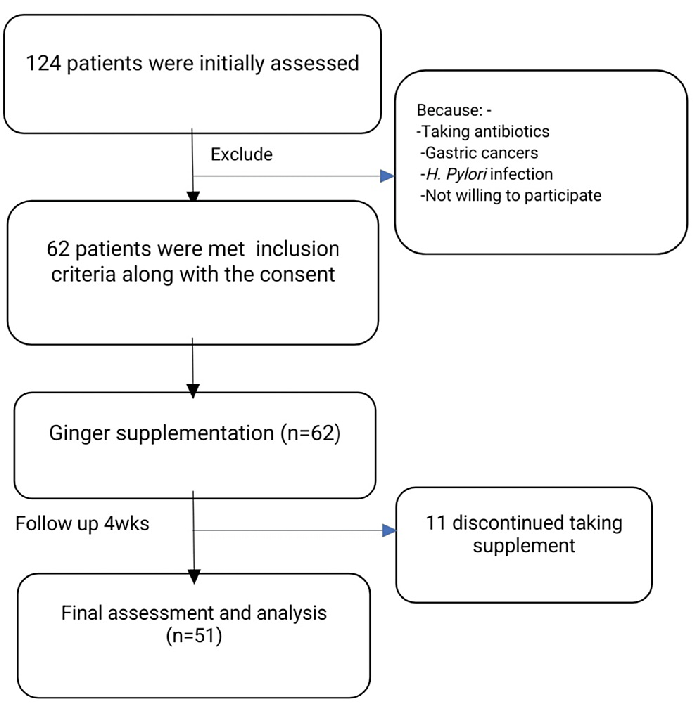
supplementation (Figure 1). The majority of the study participants were females (40/51) which represented 78.4% of the study sample.
Figure 2
Chart
694 × 707px
· 107,2 KB
Source Paper
The Effect of Ginger Supplementation on the Improvement of Dyspeptic Symptoms in Patients With Functional Dyspepsia.Cite This Figure
 > Source: Lemlem Gebremariam Aregawi et al. "The Effect of Ginger Supplementation on the Improvement of Dyspeptic Symptoms in." *Cureus*, 2023. PMID: [37771933](https://pubmed.ncbi.nlm.nih.gov/37771933/)
<figure>
  <img src="https://pdfs.citedhealth.com/figures/37771933/112.png" alt="supplementation (Figure 1). The majority of the study participants were females (40/51) which represented 78.4% of the study sample." />
  <figcaption>Figure 2. supplementation (Figure 1). The majority of the study participants were females (40/51) which represented 78.4% of the study sample.<br>  Source: Lemlem Gebremariam Aregawi et al. "The Effect of Ginger Supplementation on the Improvement of Dyspeptic Symptoms in." <em>Cureus</em>, 2023. PMID: <a href="https://pubmed.ncbi.nlm.nih.gov/37771933/">37771933</a></figcaption>
</figure>