Description
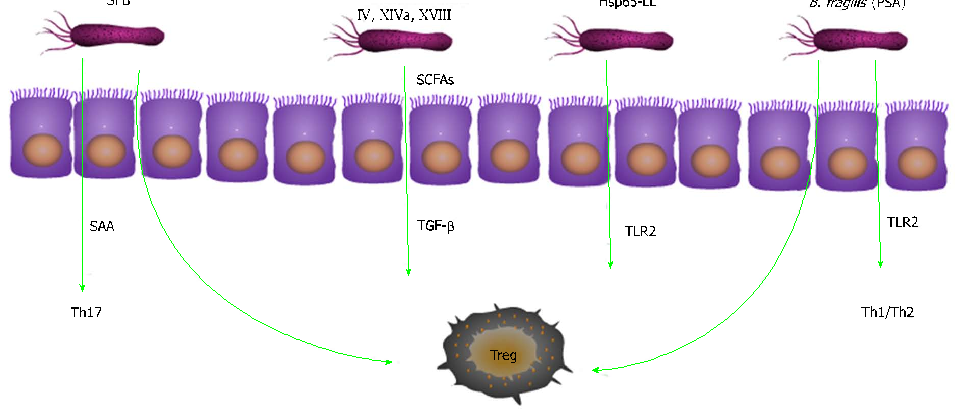
The intestinal microbiota in ulcerative colitis patients shows characteristic dysbiosis patterns, with reduced microbial diversity and altered composition compared to healthy individuals. Key bacterial phyla such as Firmicutes and Bacteroidetes are disproportionately affected.
Figure 1
Diagram
957 × 413px
· 176,7 Kio
Source Paper
Relationship between intestinal microbiota and ulcerative colitis: Mechanisms and clinical application of probiotics and fecal microbiota transplantation.Cite This Figure
 > Source: Zhao-Hua Shen et al. "Relationship between intestinal microbiota and ulcerative colitis: Mechanisms an." *World journal of gastroenterology*, 2018. PMID: [29358877](https://pubmed.ncbi.nlm.nih.gov/29358877/)
<figure>
  <img src="https://pdfs.citedhealth.com/figures/29358877/129.png" alt="The intestinal microbiota in ulcerative colitis patients shows characteristic dysbiosis patterns, with reduced microbial diversity and altered composition compared to healthy individuals. Key bacterial phyla such as Firmicutes and Bacteroidetes are disproportionately affected." />
  <figcaption>Figure 1. The intestinal microbiota in ulcerative colitis patients shows characteristic dysbiosis patterns, with reduced microbial diversity and altered composition compared to healthy individuals. Key bacterial phyla such as Firmicutes and Bacteroidetes are disproportionately affected.<br>  Source: Zhao-Hua Shen et al. "Relationship between intestinal microbiota and ulcerative colitis: Mechanisms an." <em>World journal of gastroenterology</em>, 2018. PMID: <a href="https://pubmed.ncbi.nlm.nih.gov/29358877/">29358877</a></figcaption>
</figure>