Description
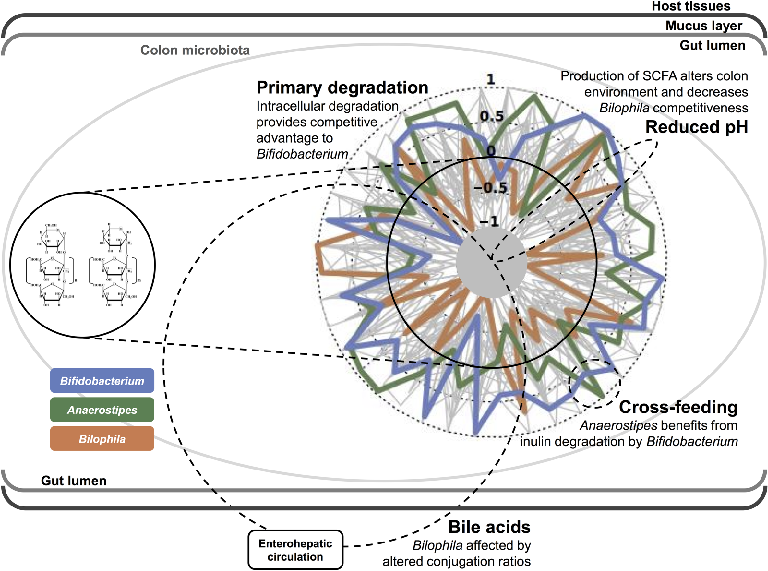
Gut microbiota composition changes induced by inulin-type fructans are characterized by increased abundance of Bifidobacterium, Faecalibacterium, and Anaerostipes, alongside decreased levels of Bilophila. These shifts are associated with altered fecal metabolite profiles.
Figure 3
Chart
768 × 571px
· 301.5 KB
Source Paper
Prebiotic inulin-type fructans induce specific changes in the human gut microbiota.Cite This Figure
 > Source: Doris Vandeputte et al. "Prebiotic inulin-type fructans induce specific changes in the human gut microbio." *Gut*, 2017. PMID: [28213610](https://pubmed.ncbi.nlm.nih.gov/28213610/)
<figure>
  <img src="https://pdfs.citedhealth.com/figures/28213610/126.png" alt="Gut microbiota composition changes induced by inulin-type fructans are characterized by increased abundance of Bifidobacterium, Faecalibacterium, and Anaerostipes, alongside decreased levels of Bilophila. These shifts are associated with altered fecal metabolite profiles." />
  <figcaption>Figure 3. Gut microbiota composition changes induced by inulin-type fructans are characterized by increased abundance of Bifidobacterium, Faecalibacterium, and Anaerostipes, alongside decreased levels of Bilophila. These shifts are associated with altered fecal metabolite profiles.<br>  Source: Doris Vandeputte et al. "Prebiotic inulin-type fructans induce specific changes in the human gut microbio." <em>Gut</em>, 2017. PMID: <a href="https://pubmed.ncbi.nlm.nih.gov/28213610/">28213610</a></figcaption>
</figure>