Description
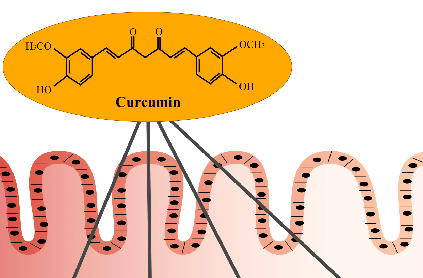
Curcumin's activity in the intestinal mucosa is illustrated, highlighting its anti-inflammatory mechanisms in the gastrointestinal tract. The diagram depicts how curcumin may modulate immune signaling pathways relevant to inflammatory bowel disease, including Crohn's disease and ulcerative colitis.
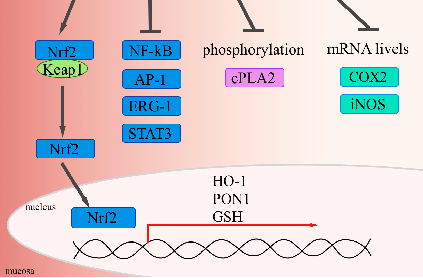
Figure 1
Diagram
423 × 278px
· 59.0 KB
Source Paper
Curcumin and inflammatory bowel disease: potential and limits of innovative treatments.Cite This Figure
 > Source: Liza Vecchi Brumatti et al. "Curcumin and inflammatory bowel disease: potential and limits of innovative trea." *Molecules (Basel, Switzerland)*, 2014. PMID: [25521115](https://pubmed.ncbi.nlm.nih.gov/25521115/)
<figure>
  <img src="https://pdfs.citedhealth.com/figures/25521115/210.png" alt="Curcumin's activity in the intestinal mucosa is illustrated, highlighting its anti-inflammatory mechanisms in the gastrointestinal tract. The diagram depicts how curcumin may modulate immune signaling pathways relevant to inflammatory bowel disease, including Crohn's disease and ulcerative colitis." />
  <figcaption>Figure 1. Curcumin's activity in the intestinal mucosa is illustrated, highlighting its anti-inflammatory mechanisms in the gastrointestinal tract. The diagram depicts how curcumin may modulate immune signaling pathways relevant to inflammatory bowel disease, including Crohn's disease and ulcerative colitis.<br>  Source: Liza Vecchi Brumatti et al. "Curcumin and inflammatory bowel disease: potential and limits of innovative trea." <em>Molecules (Basel, Switzerland)</em>, 2014. PMID: <a href="https://pubmed.ncbi.nlm.nih.gov/25521115/">25521115</a></figcaption>
</figure>